
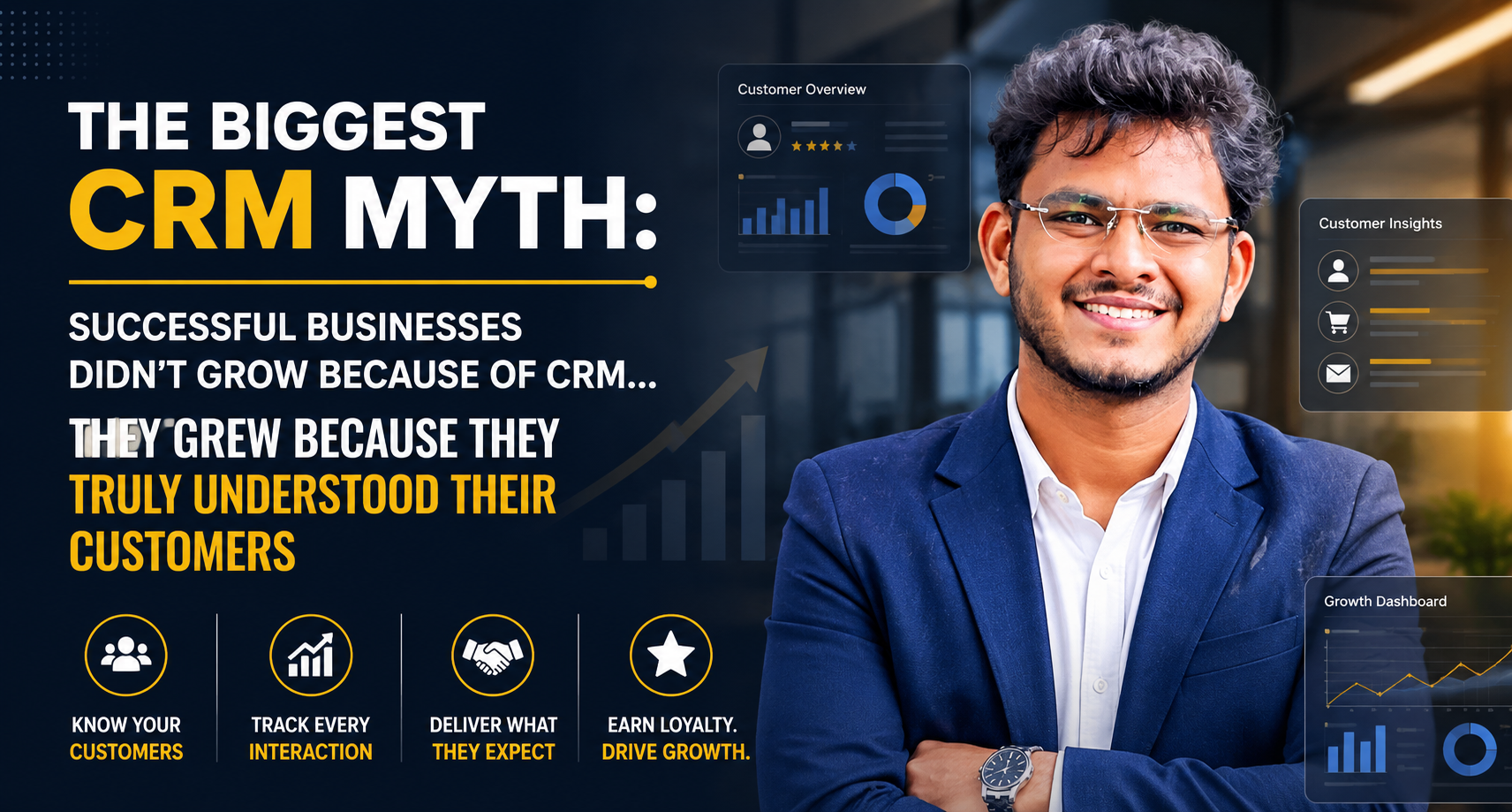
 Most Business Owners Believe This…
“CRM is only for big companies.”
If you’ve ever thought that, you’re not alone.
Many small business owners believe companies like Uber, Swiggy, Amazon, or large automobile service centers became successful because they invested in expensive CRM software.
But that’s not the real story.
The truth is much simpler and much more powerful.
These companies didn’t become successful because they had CRM.
They became successful because they understood their customers better than everyone else.
CRM was simply the tool that helped them do it consistently.
The Biggest CRM Myth
Let’s clear up one misconception.
A CRM doesn’t magically increase sales.
It doesn’t create loyal customers overnight.
And it certainly doesn’t make a business successful on its own.
A CRM simply helps you remember, organize, and act on customer information so that every customer receives a consistent experience.
Think of it this way:
A notebook stores names.
WhatsApp stores conversations.
Excel stores numbers.
But a CRM connects everything together.
It tells you:
- Who your customer is
- What they bought
- When they last visited
- What service they need next
- What they prefer
- When you should follow up
That’s where the real value lies.
Why Companies Like Uber and Swiggy Win
Imagine booking a ride.
The app already knows:
- Your pickup location
- Your favorite payment method
- Your ride history
- Your preferred destinations
Or think about ordering food.
The app remembers:
- Your favorite restaurants
- Previous orders
- Saved addresses
- Payment preferences
The experience feels effortless.
Not because someone remembered everything manually.
Because customer information is organized and used intelligently.
The customer feels understood.
That’s what creates trust.
Every Business Can Do the Same
You don’t need millions of customers.
Even if you have just 100 customers, remembering every detail becomes difficult over time.
Questions start piling up:
- Did this customer already inquire?
- When was their last purchase?
- Have we followed up?
- Did we send a quotation?
- Are they due for another service?
Without a proper system, these answers are scattered across phones, Excel sheets, notebooks, emails, and WhatsApp chats.
Eventually, opportunities are lost.
The Hidden Cost of Managing Customers Manually
Many businesses don’t realize how much money they’re losing because of poor customer management.
Some common issues include:
- Missed follow-up calls
- Forgotten service reminders
- Duplicate customer records
- Slow response times
- Inconsistent customer experience
- Poor team communication
- Lost repeat business
Most businesses assume they have a sales problem.
In reality, they often have a customer management problem.
What CRM Actually Helps You Do
A good CRM helps you build systems instead of depending on memory.
It allows you to:
- Store every customer in one place
- Track leads from inquiry to purchase
- Schedule automatic follow-ups
- Set reminders for renewals and services
- Monitor your sales pipeline
- Understand customer buying behavior
- Improve customer satisfaction
- Increase repeat business
The goal isn’t just organization.
The goal is creating better customer experiences consistently.
CRM Isn’t for Big Companies It’s for Growing Companies
One of the biggest misconceptions is that CRM is only useful after a business becomes large.
The opposite is true.
Businesses grow faster because they implement systems early.
The earlier you organize your customer information, the easier it becomes to scale without chaos.
Instead of spending time searching for information, your team spends time serving customers.
When Should You Start Using a CRM?
You should consider implementing a CRM if:
- You’re managing customers in Excel.
- Customer details are scattered across WhatsApp and notebooks.
- You’re forgetting follow-ups.
- Multiple team members handle customers.
- Repeat customers are important to your business.
- You want predictable growth.
If any of these sound familiar, the right time isn’t next year.
It’s now.
Final Thoughts
CRM isn’t just software.
It’s a smarter way of managing relationships.
The companies we admire didn’t succeed because they bought a CRM.
They succeeded because they consistently understood, served, and followed up with their customers.
The software simply made that process scalable.
If you want your business to grow, don’t ask:
“Do I need CRM?”
Instead, ask:
“How well do I really know my customers?”
The answer to that question could determine the future of your business.
Frequently Asked Questions (FAQs)
1. What is a CRM?
A CRM (Customer Relationship Management) system is software that helps businesses manage customer information, track interactions, organize leads, schedule follow-ups, and improve customer relationships.
2. Is CRM only for large businesses?
No. CRM is valuable for businesses of all sizes. In fact, small and medium businesses often benefit the most because it helps them stay organized as they grow.
3. Can I continue using Excel instead of CRM?
Excel is useful for basic record-keeping, but it isn’t designed for tracking customer interactions, reminders, follow-ups, or team collaboration. As your customer base grows, a CRM becomes much more efficient.
4. How does CRM improve customer experience?
CRM enables businesses to remember customer preferences, purchase history, previous conversations, and service schedules. This allows teams to provide faster, more personalized, and more consistent service.
5. What types of businesses should use CRM?
Almost any business can benefit, including:
- Retail stores
- Service centers
- Real estate agencies
- Healthcare clinics
- Educational institutions
- Manufacturing businesses
- B2B companies
- E-commerce businesses
6. Will CRM help increase sales?
CRM doesn’t generate sales by itself. It helps businesses manage leads effectively, improve follow-ups, reduce missed opportunities, and build stronger customer relationships, all of which can contribute to higher sales over time.
7. When is the right time to implement a CRM?
The best time is before customer management becomes difficult. If you’re already using spreadsheets, notebooks, or multiple messaging apps to manage customers, it’s a good indication that your business is ready for a CRM.
8. What’s the biggest benefit of CRM?
The biggest benefit is consistency. Every customer receives a better experience because their information, history, and interactions are organized and accessible, helping your team deliver reliable service every time.
Leave a Reply