
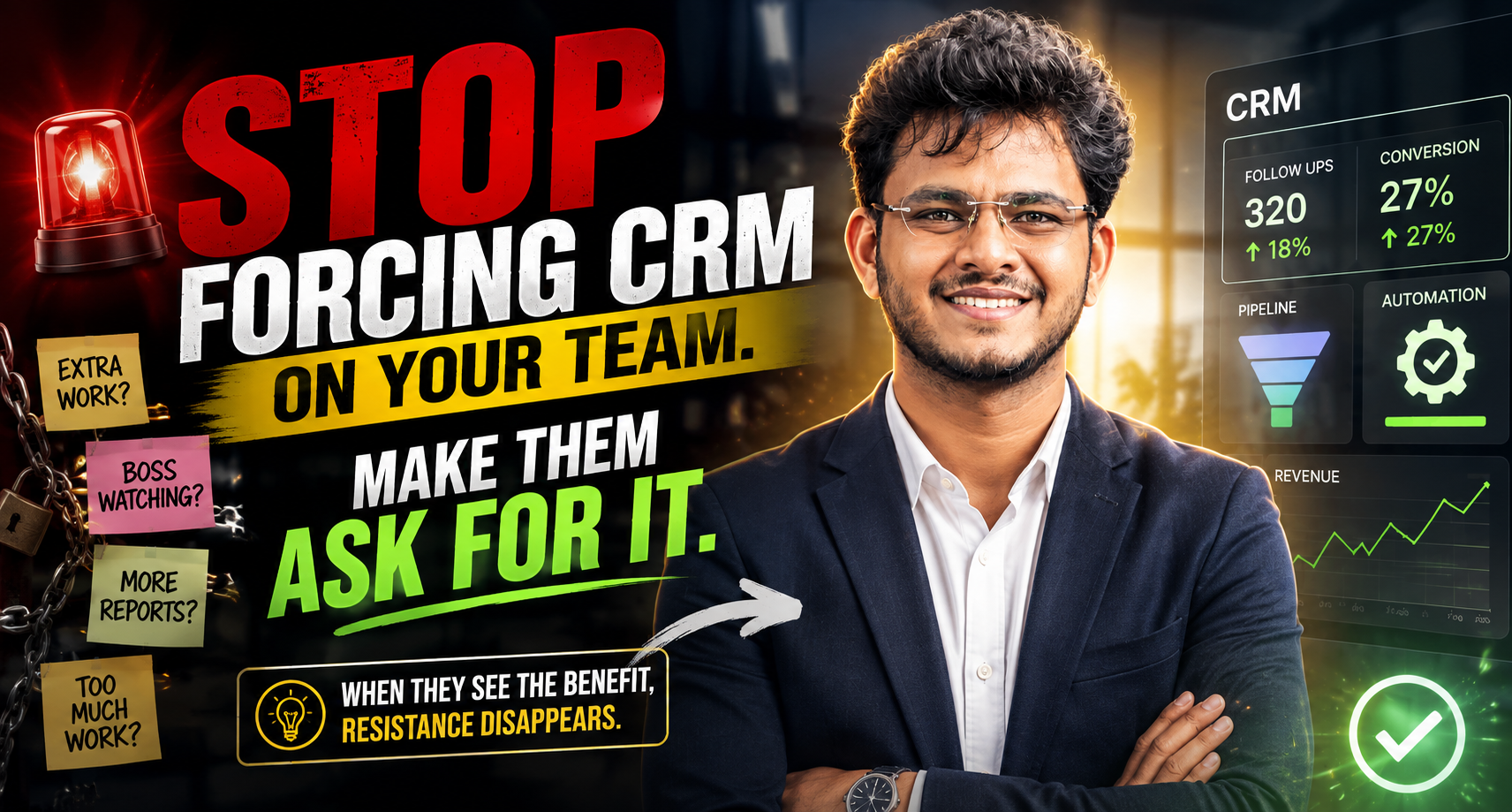
 CRM implementation often fails for one simple reason: the team doesn’t understand why they need it.
Business owners see CRM as a powerful tool for managing leads, tracking sales, automating follow-ups, and making better decisions. But employees may see it differently:
“Is this just another way for management to monitor me?”
“Will this create more work?”
“Do I really need to update another system?”
That mindset creates resistance.
The solution isn’t to force your team to use CRM. The solution is to make them understand how CRM makes their own work easier.
CRM Should Make Work Easier, Not Heavier
A good CRM should remove repetitive work, not add to it.
For sales teams, CRM can help ensure that follow-ups are never missed. Instead of remembering every customer and manually tracking every conversation, the system can organize reminders and customer information in one place.
For service teams, CRM can reduce the need for constant manual reporting. Work updates can be recorded and shared automatically, giving managers visibility without employees having to repeatedly prepare reports.
For managers, CRM turns scattered data into useful insights. Instead of simply looking at numbers, managers can identify trends, understand performance, and make better decisions.
When employees experience these benefits themselves, their perception of CRM starts to change.
The Real Reason Employees Resist CRM
Most employees don’t necessarily resist technology.
They resist extra work with no visible benefit.
If you tell your team:
“Update the CRM because management needs the data,”
they may see CRM as a management tool.
But if you show them:
“CRM will remind you about your follow-ups, organize your customer information, reduce repetitive reporting, and help you close deals faster,”
the conversation changes.
The question becomes:
“How can CRM help me?”
That is where adoption begins.
Turn Data Into Decisions
One of the biggest benefits of CRM is that it transforms raw business data into actionable insights.
Instead of managers looking at hundreds of customer records and spreadsheets, a CRM can highlight important information such as:
- Which leads need immediate attention?
- Which sales opportunities are most likely to convert?
- Where are follow-ups being missed?
- Which products or services are performing best?
- Where is the sales pipeline slowing down?
The goal isn’t simply to collect more data.
The goal is to use data to make better decisions.
Show the Benefit Before You Demand Adoption
If you want your team to embrace CRM, don’t begin with rules.
Begin with benefits.
Show the sales team how CRM saves follow-up time.
Show the service team how it reduces reporting effort.
Show managers how it provides decision-making clarity.
Show everyone how the system removes unnecessary repetitive work.
Once people understand the value, resistance naturally starts to disappear.
The Best CRM Adoption Strategy
A successful CRM rollout is less about technology and more about people.
Instead of saying:
“You have to use CRM.”
Create an environment where employees think:
“Why didn’t we have this earlier?”
That happens when CRM becomes part of their workflow instead of another task added to it.
The ultimate goal is simple:
Don’t force your team to use CRM. Make your team want CRM.
Frequently Asked Questions
1. Why do employees resist CRM?
Employees often resist CRM because they associate it with extra work, monitoring, or additional reporting. When they clearly understand how CRM benefits their daily work, adoption becomes much easier.
2. How can I get my team to use CRM?
Start by demonstrating practical benefits. Show employees how CRM can reduce manual work, simplify follow-ups, organize customer information, and eliminate repetitive reporting.
3. Is CRM mainly a monitoring tool for managers?
No. While CRM gives managers visibility into business performance, its primary value should be helping teams manage customers, automate tasks, improve follow-ups, and work more efficiently.
4. How does CRM help sales teams?
CRM can organize leads, track customer interactions, schedule follow-ups, manage sales pipelines, and provide visibility into opportunities so salespeople can focus on selling rather than remembering every task manually.
5. How does CRM help managers make better decisions?
CRM brings business data into one place and can turn that data into useful insights about sales performance, customer behavior, follow-ups, conversions, and pipeline health.
6. What is the biggest mistake companies make during CRM implementation?
The biggest mistake is focusing only on the software and ignoring employee adoption. A CRM can be technically excellent, but if employees don’t see its value, they won’t use it effectively.
7. How long does it take for a team to adopt CRM?
It depends on the complexity of the CRM, the team’s workflow, training, and how clearly the benefits are communicated. Simple workflows and strong user involvement can significantly improve adoption.
8. What is the key to successful CRM adoption?
Make the CRM useful to the employee first.
When employees feel that CRM saves time, reduces repetitive work, and helps them perform better, adoption becomes much more natural.
Final Thought
People don’t resist CRM because it’s CRM. They resist what they believe CRM will do to their work.
Change that perception.
Show them the benefit.
Make their work easier.
And eventually, you won’t have to ask:
“Is your team using CRM?”
They’ll be asking:
“When are we implementing CRM?”
Leave a Reply