
The accounting industry has undergone significant digital transformation over the last decade. Yet, many UK accounting and bookkeeping firms still find themselves managing critical processes through a combination of emails, spreadsheets, WhatsApp messages, shared drives, and manual reminders.
Despite investing in Practice Management Systems (PMS), firms often discover that operational bottlenecks remain.
This raises an important question:
Is the problem the software itself, or the fact that the software doesn’t fit the way the firm actually works?
The Hidden Challenge with Standard PMS Platforms
Most off-the-shelf Practice Management Systems are designed to serve a broad market.
To accommodate thousands of firms, they provide a wide range of features and workflows. While this sounds beneficial in theory, many firms quickly realize that:
- Their client onboarding process is different.
- Their document collection workflow is unique.
- Their compliance requirements vary.
- Their internal approval structures are specific to their practice.
- Their communication methods don’t align with the system.
As a result, teams begin creating workarounds.
They export data to spreadsheets.
They send reminders manually.
They maintain separate communication channels.
They duplicate information across multiple platforms.
Instead of simplifying operations, the software adds another layer of complexity.
Why One-Size-Fits-All Solutions Often Fall Short
Every accounting firm develops its own way of operating over time.
Some firms focus on bookkeeping and VAT returns.
Others specialize in year-end accounts, payroll, tax advisory, or outsourced finance services.
Each service line brings unique workflows, client interactions, and deadlines.
A generic PMS may provide standard workflows, but it rarely accommodates every firm’s operational model without compromise.
This is where many firms reach a crossroads:
Continue adapting their processes to fit the software or implement software that adapts to their processes.
The Rise of Custom Practice Management Systems
More UK accounting firms are now investing in custom PMS solutions designed around their existing workflows.
Rather than forcing teams to change how they work, custom systems are built to support established processes while eliminating inefficiencies.
The objective isn’t simply digitization.
The objective is operational alignment.
When software reflects the way a firm already operates, adoption becomes easier and productivity improves significantly.
Key Benefits of a Custom PMS for Accounting Firms
1. Automated Document Collection and Follow-Ups
One of the biggest productivity drains in accounting firms is chasing client documents.
Custom PMS platforms can automatically:
- Request required documents
- Send reminder sequences
- Escalate overdue requests
- Track submission status
This reduces administrative effort and improves turnaround times.
2. Real-Time Deadline and Compliance Tracking
Missing a filing deadline can have serious consequences.
A custom PMS provides:
- Centralized deadline management
- Automated alerts
- Real-time status monitoring
- Team accountability dashboards
This gives firms greater control over compliance obligations.
3. Centralized Client Communication
Client conversations often become fragmented across:
- Emails
- Phone calls
- Internal notes
A custom solution consolidates communication and client records into a single source of truth, improving visibility and reducing information loss.
4. Reduced Administrative Work
Many firms spend hours every week on repetitive tasks such as:
- Updating statuses
- Sending reminders
- Creating reports
- Tracking outstanding items
Automation eliminates much of this manual workload, allowing staff to focus on higher-value client work.
5. Workflows Built Around Your Firm
Perhaps the greatest advantage of a custom PMS is flexibility.
Instead of changing your firm’s processes to fit the software, the system is designed to reflect:
- Existing workflows
- Team structures
- Approval hierarchies
- Service delivery models
- Reporting requirements
The result is a solution that feels natural to use rather than restrictive.
6. Improved Productivity and Accountability
When every task, deadline, and responsibility is visible within a centralized system:
- Team members know what needs attention.
- Managers gain operational visibility.
- Bottlenecks become easier to identify.
- Performance becomes measurable.
This creates stronger accountability across the organization.
Signs Your Current PMS May Be Holding Your Firm Back
Your firm may benefit from a custom PMS if:
✓ Staff still rely heavily on spreadsheets.
✓ Client documents are frequently delayed.
✓ Teams manually chase clients for information.
✓ Important updates are scattered across multiple channels.
✓ Managers struggle to track workload and deadlines.
✓ Employees have developed numerous workarounds to bypass system limitations.
If these challenges sound familiar, the issue may not be your team it may be the software’s inability to support your processes effectively.
The Future of Practice Management
The future of accounting technology is not simply adding more features.
It is creating systems that align with how firms actually operate.
Successful accounting firms are increasingly focusing on:
- Workflow automation
- Process standardization
- Operational visibility
- Data-driven decision-making
- Customized technology ecosystems
A custom Practice Management System becomes more than software it becomes the operational backbone of the firm. 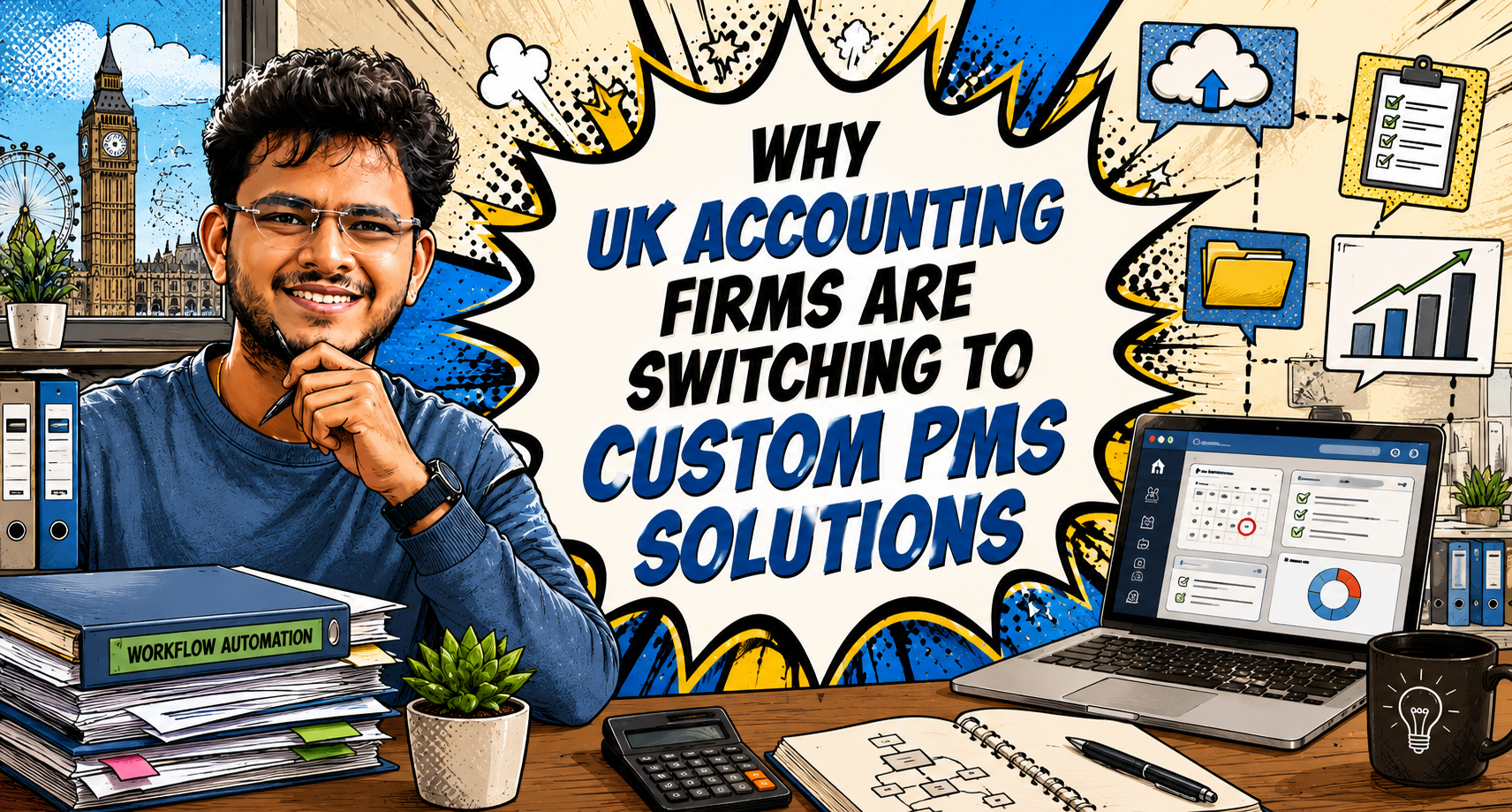
Final Thoughts
Technology should simplify operations, not complicate them.
If your team continues to depend on spreadsheets, emails, manual follow-ups, and disconnected tools despite having a PMS in place, it may be time to reassess whether the software truly supports your firm’s needs.
The most effective systems are not necessarily the ones with the most features.
They are the ones that fit the way your firm works.
Frequently Asked Questions (FAQ)
Q1. What is a Custom Practice Management System (PMS)?
A Custom PMS is a practice management solution specifically designed around a firm’s unique workflows, processes, compliance requirements, and operational structure instead of using standardized workflows found in off-the-shelf software.
Q2. How is a custom PMS different from a standard PMS?
A standard PMS offers predefined features for a broad audience. A custom PMS is tailored to your firm’s specific requirements, allowing greater flexibility, automation, and process alignment.
Q3. Is a custom PMS suitable for small accounting firms?
Yes. Small and mid-sized firms often benefit the most because they can automate repetitive tasks, improve client communication, and scale operations without significantly increasing administrative overhead.
Q4. Can a custom PMS integrate with existing accounting software?
Yes. Most custom PMS solutions can integrate with accounting platforms, document management systems, CRM tools, email systems, and other business applications.
Q5. What processes can be automated in a custom PMS?
Common automations include:
- Client onboarding
- Document collection
- Reminder notifications
- Deadline tracking
- Task assignment
- Compliance monitoring
- Reporting and dashboards
Q6. Does a custom PMS improve team productivity?
Yes. By reducing manual work, centralizing information, and automating repetitive processes, teams can focus more on client service and value-added activities.
Q7. How do I know if my firm needs a custom PMS?
If your team still depends heavily on spreadsheets, emails, manual follow-ups, and disconnected tools despite using a PMS, a custom solution may provide significant operational improvements.
Q8. What is the biggest advantage of a custom PMS?
The biggest advantage is alignment. The software adapts to your firm’s processes rather than forcing your firm to adapt to the software.
What challenges are you currently facing with your Practice Management System? Share your experience in the comments and let’s discuss practical solutions for modern accounting firms.
#Accounting #Bookkeeping #PracticeManagement #AccountingFirm #UKAccounting #WorkflowAutomation #Productivity #DigitalTransformation #AccountingTechnology #PMS
Leave a Reply