
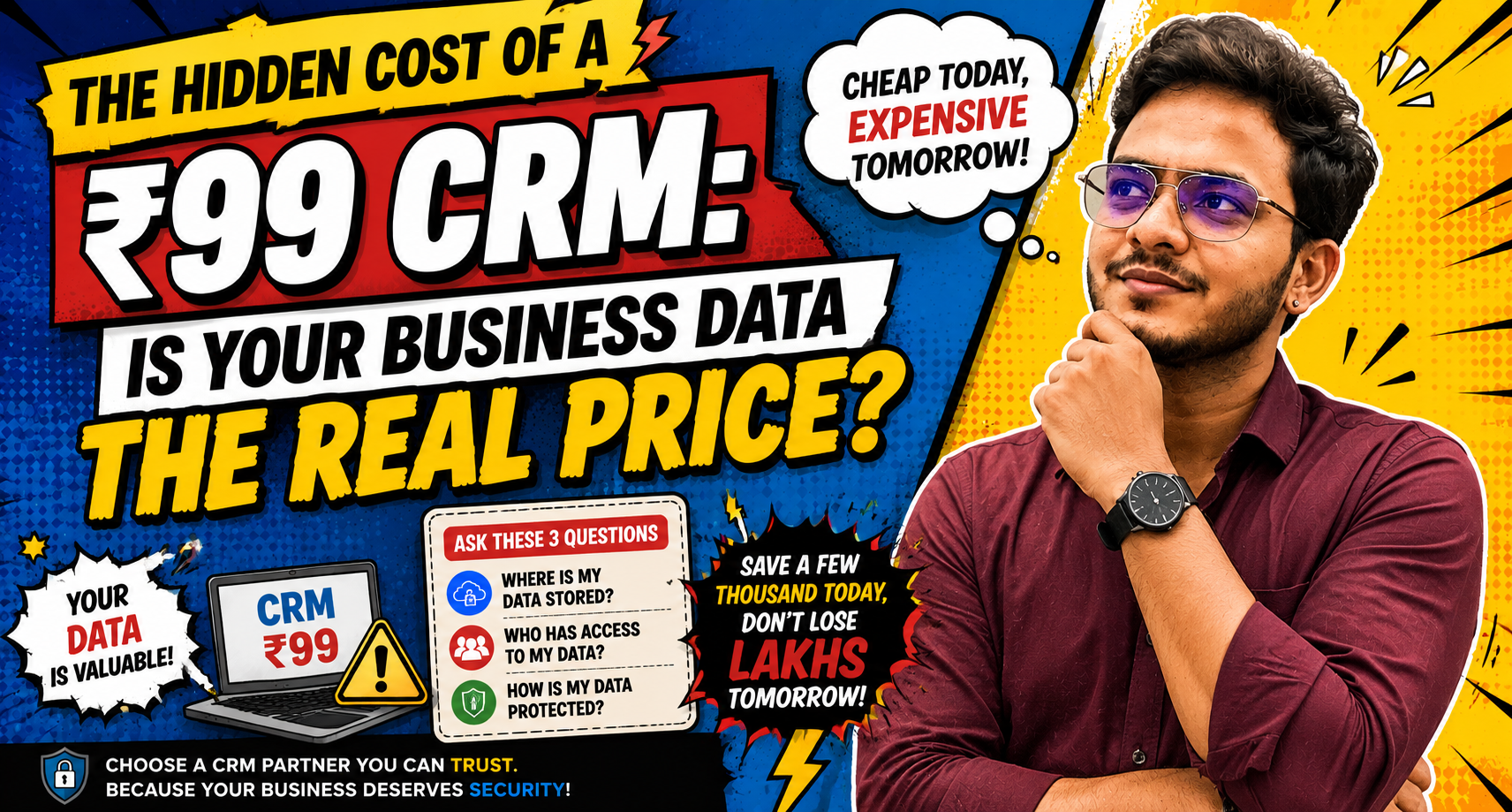
In today’s digital world, Customer Relationship Management (CRM) software has become an essential tool for businesses of all sizes. Whether you’re managing leads, tracking customer interactions, or automating sales processes, a CRM helps streamline operations and improve productivity.
But have you ever wondered how some CRM providers offer their software for just ₹99 or ₹199 per month?
At first glance, it seems like an incredible deal. However, before making your decision based solely on price, there’s an important question every business owner should ask:
What Is the Real Cost of a Cheap CRM?
When evaluating CRM software, most businesses compare features and pricing. While pricing matters, it’s equally important to understand how your business data is collected, stored, and protected.
Your CRM contains some of your company’s most valuable assets:
- Customer information
- Sales opportunities
- Business communications
- Pricing strategies
- Revenue forecasts
- Marketing data
- Internal notes and documents
In many cases, the value of this data far exceeds the cost of the software itself.
Why Are Some CRM Solutions So Affordable?
Not every low-cost CRM is risky. Some providers offer affordable pricing to attract new customers or support small businesses.
However, businesses should understand:
- How the provider generates revenue
- Whether there are hidden costs
- How customer data is managed
- What security measures are in place
- Whether the platform can scale as your business grows
A low monthly fee should never come at the expense of security, privacy, or reliability.
The Hidden Risk: Your Business Data
Imagine if unauthorized individuals gained access to:
- Your customer database
- Your sales pipeline
- Your pricing structure
- Your future business plans
The impact could include:
- Lost customers
- Competitive disadvantages
- Financial losses
- Reputation damage
- Compliance issues
The reality is simple: your business data is often worth far more than the CRM subscription fee.
3 Essential Questions to Ask Before Choosing a CRM
1. Where Is My Data Stored?
Ask your CRM provider:
- Which country hosts the data?
- Is the data stored on reputable cloud infrastructure?
- Are regular backups maintained?
Understanding data storage practices helps you evaluate security and compliance standards.
2. Who Has Access to My Data?
A trustworthy CRM provider should clearly explain:
- Employee access controls
- User permissions
- Data encryption practices
- Administrative access policies
The principle should be simple: only authorized individuals should access your data.
3. How Is Data Security Managed?
Ask about:
- Encryption methods
- Security monitoring
- Data backup procedures
- Disaster recovery plans
- Compliance certifications
Transparent answers indicate a provider that takes security seriously.
Beyond Price: What Really Matters in a CRM?
When selecting a CRM, consider:
Security
Your customer and business data must be protected.
Reliability
Downtime can disrupt sales and customer relationships.
Scalability
The CRM should grow with your business.
Customer Support
Reliable support can save time and prevent costly issues.
Trust
Your CRM provider becomes a long-term technology partner.
Final Thoughts
Saving money is important. But choosing a CRM solely because it’s the cheapest option can be a costly mistake.
Before investing in any CRM, ask the right questions about data ownership, access, storage, and security.
Remember:
A CRM is not just software. It is the central repository of your business intelligence.
Choose a CRM provider that values security, transparency, and trust as much as you do.
Because sometimes, the real price of a ₹99 CRM isn’t ₹99 it’s your data.
Frequently Asked Questions (FAQ)
1. Is a low-cost CRM always unsafe?
No. A low-cost CRM is not automatically unsafe. Many providers offer affordable plans while maintaining strong security standards. The key is to verify their data protection practices before making a decision.
2. What should I check before buying a CRM?
You should verify:
- Data storage location
- Security measures
- User access controls
- Backup policies
- Customer support quality
- Data ownership terms
- Scalability options
3. Why is CRM data security important?
CRM systems contain sensitive customer and business information. A security breach can lead to financial losses, customer trust issues, and operational disruptions.
4. Who owns the data stored in a CRM?
In most cases, the customer owns the data. However, you should always review the provider’s terms of service and privacy policy to understand data ownership and usage rights.
5. Can CRM providers access my data?
Some providers may have limited administrative access for support and maintenance purposes. Reputable vendors implement strict access controls, monitoring, and encryption to protect customer information.
6. What security features should a CRM offer?
Look for:
- Data encryption
- Role-based access controls
- Multi-factor authentication (MFA)
- Regular backups
- Audit logs
- Security monitoring
- Compliance certifications
7. How can I know if a CRM provider is trustworthy?
Ask for information about:
- Security certifications
- Customer references
- Data protection policies
- Service-level agreements (SLAs)
- Backup and disaster recovery procedures
Transparency is often a strong indicator of trustworthiness.
8. Is cloud-based CRM secure?
Yes, many cloud-based CRM platforms are highly secure when managed by reputable providers. Security depends on the provider’s infrastructure, policies, and ongoing monitoring practices.
9. What happens if I want to switch CRM providers later?
Before purchasing, confirm that:
- Your data can be exported easily
- There are no hidden exit fees
- Data migration support is available
A good CRM should never lock you into its platform.
10. Should I choose a CRM based on price alone?
No. Price should be only one factor in your decision. Security, reliability, support, scalability, and trust should carry equal or greater importance than cost.
Leave a Reply