
For most MSME business owners, Excel is often the first tool used to manage customers, leads, quotations, and sales activities.
And honestly, there’s nothing wrong with that.
In the early stages of a business, Excel is simple, flexible, and cost-effective. You can create your own columns, track enquiries, maintain customer details, and manage your sales pipeline without investing in additional software.
But as your business grows, the way you manage information also needs to evolve.
The question is not whether Excel is good or bad.
The real question is:
“Has my business reached a stage where Excel is no longer enough?”
When Excel Works Perfectly
Excel is a great choice if:
- You are a solo entrepreneur or have a small team.
- You manage around 20-30 active leads at a time.
- Your sales process is straightforward.
- Customer interactions are handled by one person.
- Follow-ups are easy to remember and track.
In such situations, Excel provides everything you need without adding complexity.
There’s no need to invest in a CRM just because others are using one.
The Challenges Start When Business Grows
As your business attracts more customers, new challenges begin to appear.
You may notice situations like:
- More than 50 active leads in the pipeline.
- Multiple employees interacting with the same customer.
- Customer information spread across Excel sheets, WhatsApp chats, emails, and phone notes.
- Missed follow-ups and delayed responses.
- Difficulty tracking sales performance.
At this stage, questions like these become common:
- Who last spoke with this customer?
- Was the quotation sent?
- When is the next follow-up due?
- Which leads are likely to convert this month?
Finding answers often requires checking multiple files, chats, and emails.
This is where productivity starts to suffer.
What Is a CRM?
Many business owners think CRM is just another software.
In reality, CRM (Customer Relationship Management) is a centralized system that helps you organize and manage customer relationships.
Instead of customer information being scattered across different platforms, everything stays in one place.
A CRM typically helps you manage:
- Leads
- Customers
- Follow-ups
- Quotations
- Sales activities
- Projects
- Support requests
This gives your team a single source of truth.
How CRM Helps Growing MSMEs
A CRM can solve many common growth challenges.
Better Follow-Up Management
No more relying on memory or sticky notes.
The system automatically reminds your team about pending follow-ups and scheduled activities.
Complete Customer History
Anyone in your team can instantly see:
- Previous conversations
- Quotes shared
- Meetings conducted
- Tasks completed
This improves customer experience and reduces confusion.
Team Visibility
As a business owner, you gain better visibility into:
- Lead status
- Employee activities
- Sales performance
- Conversion rates
You no longer need to ask for updates every day.
Faster Reporting
Instead of manually preparing reports in Excel, CRM dashboards can provide insights within seconds.
Does Every MSME Need a CRM?
Not necessarily.
Many businesses adopt CRM too early and end up paying for features they don’t use.
A CRM becomes valuable when:
✅ Your lead volume is increasing.
✅ Multiple people are involved in sales or customer service.
✅ Follow-ups are getting missed.
✅ Customer information is scattered.
✅ You need better visibility into business operations.
If these problems sound familiar, it’s probably time to explore CRM solutions.
Excel vs CRM: A Simple Rule
Use Excel when:
- Your team is small.
- Lead volume is manageable.
- Processes are simple.
Consider CRM when:
- Your team is growing.
- Lead management becomes difficult.
- Customer information is spread across multiple tools.
- You need accountability and visibility.
Final Thoughts
Excel is an excellent starting point for any MSME.
In fact, many successful businesses begin with Excel.
But growth creates new challenges.
The goal isn’t to replace Excel because it’s outdated.
The goal is to adopt a CRM when your business needs better organization, collaboration, and visibility.
The right time to move from Excel to CRM is not when everyone else is doing it.
It’s when your business starts feeling the limitations of Excel.
And for many growing MSMEs, that moment arrives sooner than they expect.
Frequently Asked Questions (FAQs)
1. Is Excel enough for managing a small business?
Yes. If you have a small team, limited leads, and a simple sales process, Excel can be an effective and affordable solution for managing customer and sales data.
2. When should an MSME consider moving from Excel to a CRM?
You should consider a CRM when your lead volume increases, multiple employees handle the same customers, follow-ups are getting missed, or customer information is spread across multiple tools.
3. What are the limitations of Excel for lead management?
Excel can become difficult to manage as data grows. It doesn’t provide automated follow-up reminders, activity tracking, team collaboration, or real-time visibility into customer interactions.
4. What is a CRM and how does it help businesses?
A CRM (Customer Relationship Management) system helps businesses manage leads, customers, follow-ups, sales activities, and communication from a centralized platform.
5. Can a CRM improve customer follow-ups?
Yes. Most CRM systems automatically schedule reminders, track customer interactions, and help teams ensure that no lead or follow-up opportunity is missed.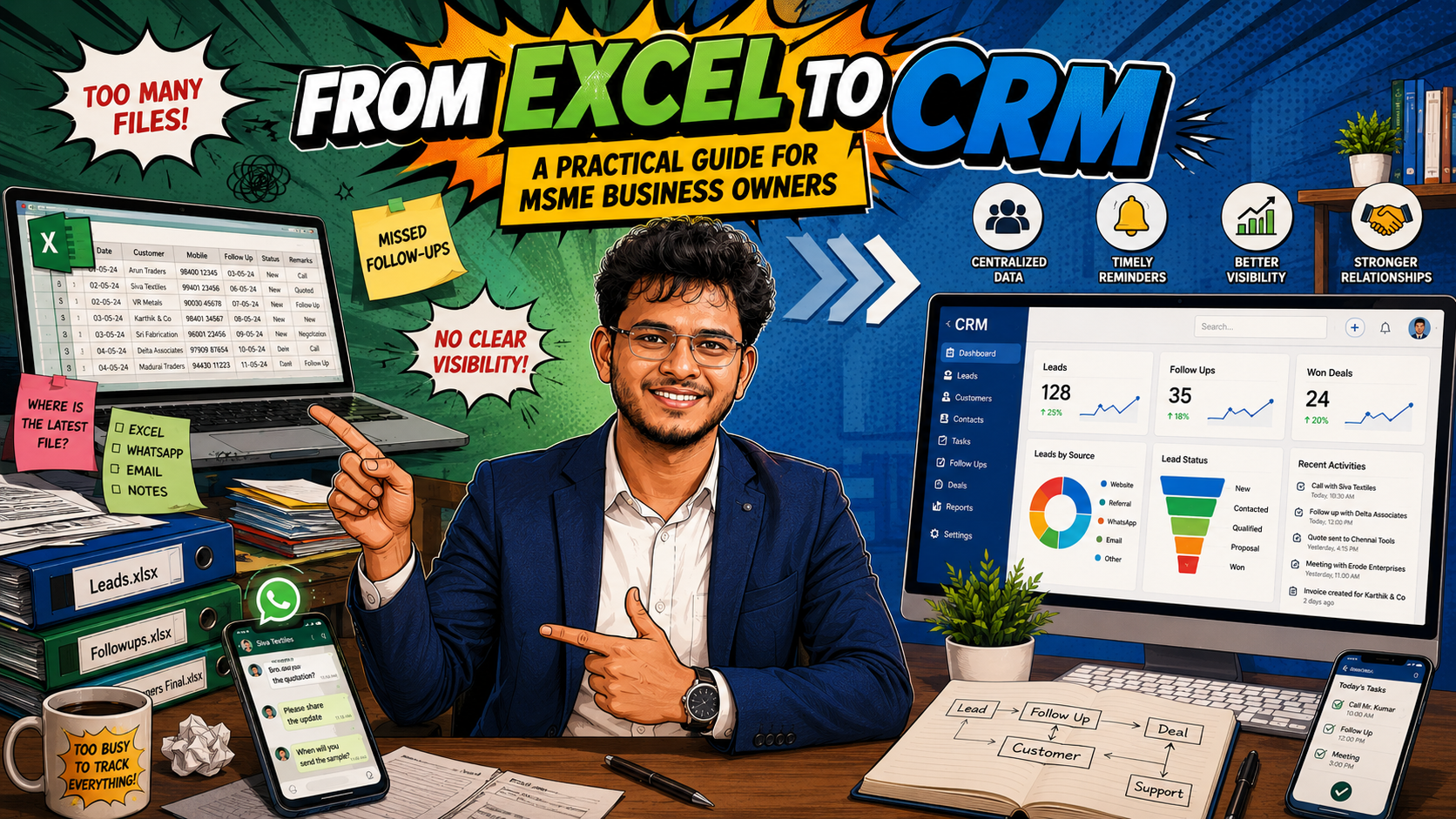
Leave a Reply