
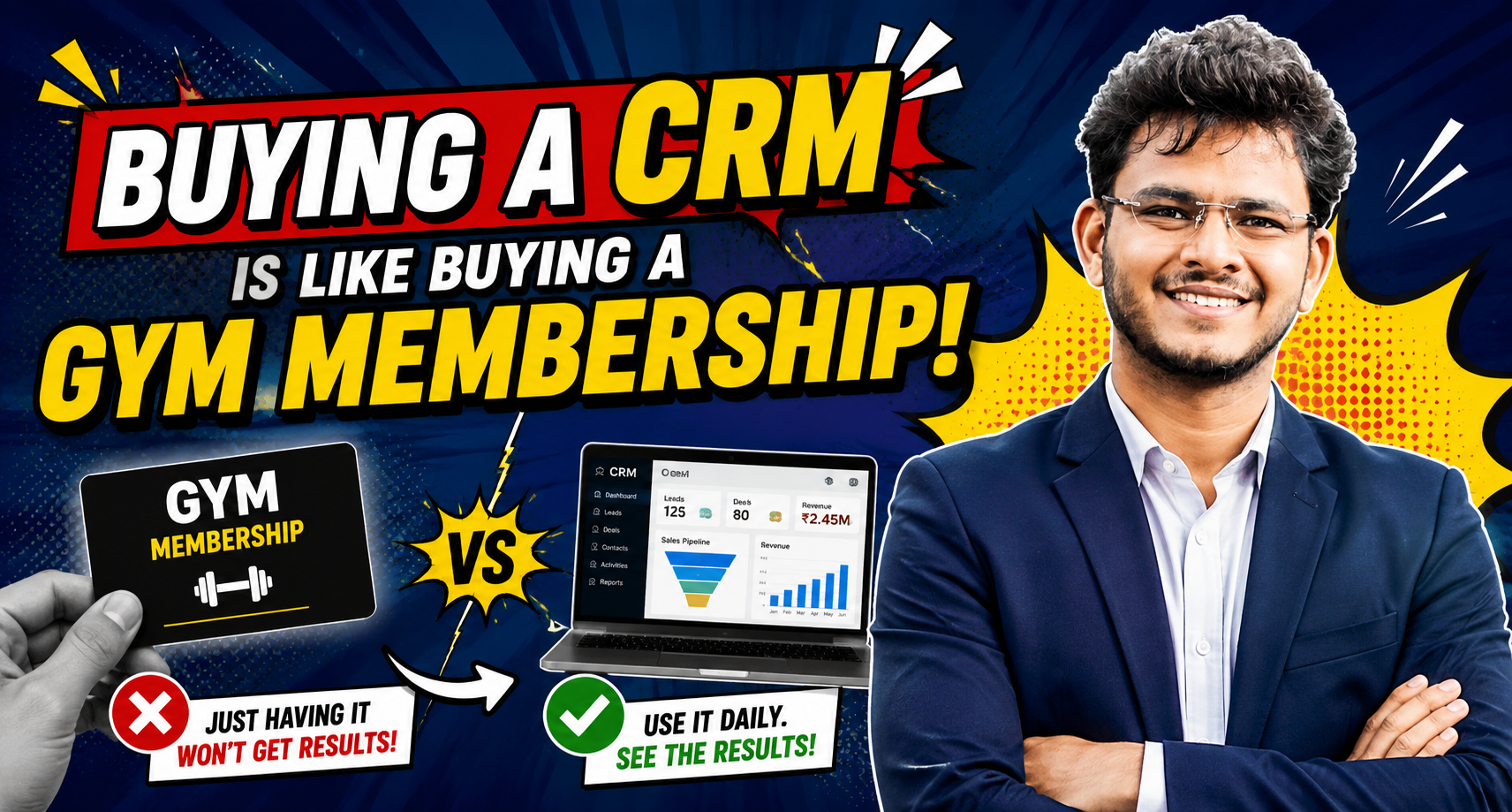
 You Don’t Get Results by Buying. You Get Results by Using.
Imagine this.
You buy a premium gym membership at the best fitness center in town. You feel excited. You even buy new workout clothes and shoes.
But after that?
The membership card stays in your wallet.
Weeks turn into months. The gym never sees you.
Now ask yourself…
Will you get fitter?
Will you build muscle?
Will you lose weight?
Of course not.
The gym wasn’t the problem.
The lack of consistency was.
The same thing happens with CRM software.
Buying CRM Doesn’t Improve Your Business
Many businesses believe that purchasing a CRM will automatically increase sales, improve customer relationships, and organize operations.
Unfortunately, that’s not how CRM works.
Installing CRM software is only the beginning.
Without proper implementation, training, and regular monitoring, even the best CRM becomes another unused software subscription.
Why Most CRM Implementations Fail
Businesses usually invest in CRM with great expectations.
But after a few months, the excitement disappears.
The CRM slowly becomes another forgotten tool.
Here’s why.
1. No Proper Team Training
Employees don’t know why they should use it.
They don’t understand how it helps them.
Instead of simplifying work, CRM feels like extra work.
Without training, adoption never happens.
2. No Standard Process
Everyone enters data differently.
Some skip updates.
Some forget follow-ups.
Some don’t use it at all.
A CRM is only as good as the process behind it.
3. No Management Reviews
Many business owners install CRM and expect it to run automatically.
They never check:
- Sales activities
- Follow-up completion
- Lead status
- Team performance
If leadership doesn’t review CRM regularly, employees stop taking it seriously.
4. No Accountability
When nobody checks CRM usage, nobody feels responsible.
Salespeople return to WhatsApp, Excel sheets, sticky notes, and memory.
Soon the CRM becomes empty.
The Real Problem Isn’t CRM
After three months, many business owners say:
“CRM doesn’t work for our business.”
But here’s the truth.
The CRM didn’t fail.
The implementation failed.
Even the world’s best software cannot fix poor processes.
CRM Success Requires Habit
Think about fitness.
A trainer gives you a workout plan.
But you still have to:
- Show up regularly
- Follow the routine
- Track progress
- Stay disciplined
CRM works exactly the same way.
Your team must build the habit of using it every day.
What Makes a CRM Successful?
Successful CRM implementation includes much more than software.
Team Training
Everyone should know:
- How to use CRM
- Why it matters
- What’s expected from them
Process Setup
Define clear workflows like:
- Lead capture
- Lead assignment
- Follow-up schedule
- Sales pipeline
- Customer communication
Regular Reviews
Review CRM weekly or monthly.
Track:
- Pending follow-ups
- Sales conversion
- Lead response time
- Team performance
What gets measured gets improved.
Continuous Support
People don’t change habits overnight.
They need guidance.
Questions need answers.
Processes need improvement.
That is why ongoing support matters.
Software Alone Isn’t Enough
Many CRM vendors stop after installation.
They provide login credentials and leave.
But software without implementation creates very little business value.
Businesses need someone who helps them:
- Configure the CRM
- Train the team
- Build workflows
- Monitor adoption
- Improve processes
That is what drives real ROI.
Think of CRM as a Business System
A CRM isn’t just software.
It’s the operating system for your sales process.
When used consistently, it helps you:
- Never miss follow-ups
- Track every customer interaction
- Increase sales visibility
- Improve customer experience
- Make better business decisions
But only if your team actually uses it.
Final Thoughts
Buying a CRM is exactly like buying a gym membership.
The purchase is easy.
The transformation comes from consistent action.
Don’t judge your CRM after installation.
Judge it after your team has been properly trained, supported, and using it consistently.
Because success doesn’t come from owning the tool.
It comes from using it.
Frequently Asked Questions (FAQs)
1. Why do most CRM implementations fail?
Most CRM projects fail because businesses don’t invest enough in user training, process setup, leadership reviews, and team adoption. The software is rarely the problem.
2. How long does it take to successfully implement a CRM?
Most small and medium-sized businesses can implement a CRM successfully within 30–90 days, depending on team size, business processes, and training.
3. Is training necessary after installing CRM software?
Yes. Without proper training, employees often avoid using the CRM or use it incorrectly, leading to poor data quality and low adoption.
4. How often should business owners review CRM reports?
A weekly review is recommended for sales teams, while a monthly strategic review helps business owners track performance, identify bottlenecks, and improve processes.
5. What’s the difference between CRM software and CRM implementation?
CRM software is the tool itself. CRM implementation includes setup, customization, team training, workflow creation, user adoption, and ongoing support. Implementation determines whether the CRM delivers results.
6. Can a CRM increase sales?
Yes, when used consistently. A well-implemented CRM improves lead tracking, follow-ups, customer communication, and sales visibility, all of which can contribute to higher conversion rates.
7. What are the signs that my CRM isn’t being used properly?
Common signs include:
- Low user logins
- Missing or incomplete customer data
- Missed follow-ups
- Sales managed in Excel or WhatsApp instead of the CRM
- Inaccurate sales reports
8. What should I look for in a CRM implementation partner?
Choose a partner who offers:
- Business process mapping
- CRM customization
- Team training
- Workflow automation
- Ongoing support
- Regular performance reviews
Leave a Reply